
National Rimfire Benchrest Association of Ireland (NRBAI)


RIMFIRE BENCHREST
No age limit, no size requirement, no gender preference, no language barriers. . . just one big family of shooters enjoying the spirit of competition and camaraderie. Ron Robles 2013
So what is this sport?
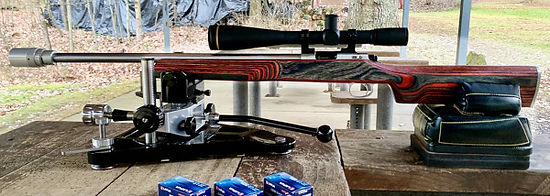
Simply exactly as it sounds, shooting from a bench using rests; a relatively complex front rest and utilising a rear bag, to hold the rifle in a stable position. It is a test of accuracy and skill; related to the rifle, the ammunition, skill of the shooter (particularly in relation to shooting position), shooting technique and reading of prevailing wind conditions. Much patience is required to ‘time’ your shot for ultimate accuracy.
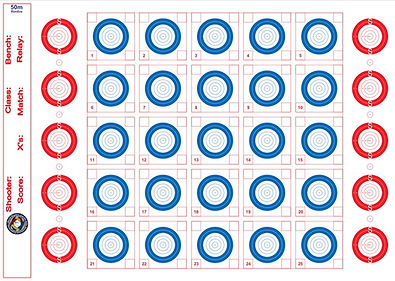
The target is shot from 50Meters outdoors; the overall target is about the size of an A3 page. It compromises of 25 scoring targets, each of a maximum of 10 points with an ‘X’ ring in the centre. This gives a maximum possible score of 250 – 25 x. Matches often include shooting multiple cards. The time allowed to shoot a card is 20 or 30 minutes (20 Minutes for all International competitions).
There are 4 Classes of competition in Ireland,
FACTORY SPORTER.
This is any Factory Sporter having only manually and mechanically operated firing mechanism, maximum weight not more than 10 ½ lbs. (7.763Kgs) inclusive of scope. Additional barrel weights or harmonic tuners or bullet stabilizers, barrel attachments (vibration devices) are NOT permitted. Any scope may be used with a maximum magnification of 12x, however where variable power scopes are used they will have to be taped in position to a magnification of not more than 12x, by referee for the duration of the match. The barrel/action can be bedded and have the trigger reworked but not replaced. The barrel profile must be a fixed piece of metal, however formed with no movable attachments except for the action nut to attach the barrel to the action. (Original front sights may be left in place but not altered in any way) Stock or Stocks that meet the ‘Stock Clarification’ rules may be used. Return to battery shall NOT be permitted. No electronic or mechanically assisted triggers allowed. The ammunition must be magazine fed with a minimum capacity of 2 rounds. Only "Original Equipment Manufacture" (OEM) complete rifles can be used, rifles as available to purchase without modifications. Bi-pods may be used with a maximum weight of 800gr. They are not weighed with the rifle.
INTERNATIONAL SPORTER
This is any Sporter having only manually and mechanically operated firing mechanism, maximum weight not more than 8 ½ lbs. (3.855Kgs) inclusive of scope. Additional barrel weights or harmonic tuners or bullet stabilizers, barrel attachments (vibration devices) are NOT permitted. Any scope may be used with a maximum magnification of 12x, however where variable power scopes are used they will have to be taped in position to a magnification of not more than 12x, by referee for the duration of the match. The barrel/action can be bedded and have the trigger reworked/replaced. The barrel profile must be must be a fixed piece of metal, however formed with no movable attachments except for the action nut to attach the barrel to the action. (Original front sights may be left in place but not altered in any way) Stock or Stocks that meet the Stock Clarification’ rules may be used. Return to battery shall NOT be permitted. No electronic or mechanically assisted triggers allowed.
LIGHT RIFLE
This is any RIFLE having only manually and mechanically operated firing mechanism, maximum weight not more than 10.5Llbs (4.762Kgs) inclusive of scope. Any modifications can be made to the rifle and any scope may be used. Factory stocks or stocks that meet ‘Stock Clarification’ rules may be used. Return to battery shall NOT be permitted. Barrel weights harmonic tuners or bullet stabilisers are permitted but will be included in the overall weight of the gun. No electronic or mechanically assisted triggers allowed. Stock tape is permitted
HEAVY RIFLE
This is any RIFLE having only manually and mechanically operated firing mechanism, maximum weight not more than 15Llbs (6.803Kgs) inclusive of scope. Any modifications can be made to the rifle and any scope may be used. Factory stocks or stocks that meet ‘Stock Clarification’ rules may be used. Return to battery shall NOT be permitted. Barrel weights harmonic tuners or bullet stabilisers are permitted but will be included in the overall weight of the gun. . No electronic or mechanically assisted triggers allowed. Stock tape is permitted. No rail guns will be permitted.
STOCK CLARIFICATION RULES
FACTORY SPORTER; the action may be glued into the stock. Stock must be 57.51 (2.25inch)or under at its widest point. No stock tape allowed. Fore end and butt of stock that comes in contact with front and rear sandbags should be convex. Beaver tail fore end is allowed if OEM. The stock must be OEM from the manufacturer of the rifle. The stock cannot be modified by the addition of pieces or sections which change its original shape.
INTERNATION SPORTER; the action may be glued into the stock. The stock width can be maximum 57.15mm (2.25”). The stock must measure 57.15mm for the first 5” of the stock measured from the front end of the stock. No stock tape allowed. For-end and butt of stock that comes in contact with front and rear sandbags can be flat or convex. The bottom of the butt of the stock that comes in contact with rear sandbag must be either convex or flat. If flat the bottom of the butt of stock must be 25mm (0.98") or under in width.
LIGHT AND HEAVY VARMINT CLASSES; the forearm of the stock must be either convex or flat, maximum 76.2mm(3inch)or under at its widest point, this can be a specialist stock or via a flat plate attached to the bottom of the stock, any material can be used. The bottom of the butt that comes in contact with rear sandbag must be either convex or flat. If flat the bottom of the butt of the stock must be25mm (.98inch) or under in width
Accuracy tends to increase from Factory Sporter to Heavy Varmint. Factory or International Sporter can be used in LV and HV. LV will also qualify for HV.
It appears that many people in Ireland now are using 2 rifles for 3 classes, that is they are using a L.V. rifle for both L.V. and H.V. and also have a sporter rifle. It can be difficult to keep a good target rifle with large magnification scope and barrel tuner under 10.5lbs but it is possible
EQUIPMENT LIST
-
Rifle
-
Scope and Rings
-
Tuner
-
Front Rest
-
Rear Bag
-
Wind Flags
-
Ammunition
1 RIFLE
A good Factory Sporter rifle is any of the CZ’s 452,453,455; Anschutz 1416 , Sako Rimfire etc.
CZ453,Anschutz 1416.
A good L.V. or H.V. would be Anschutz 54 or 64 action (with 54 being the better), There are many other brands Some rarer such as , Bleiker, GRUNIG & Elminger,, Walter KK500, or even a custom (built from parts that you decide on) with actions from, Holeshot, PQP 2500X,Turbo etc, where you select your barrel, trigger and stock seperatly.
The Best Starter rifle will always be a second hand unit as most rifles that are looked after are good for over 100,000 rounds. Test shoot before purchase !!
2 SCOPE and Rings
For Factory Sporter any scope is adequate once you can set the power to 12x or below, the finer the crosshair the better.
For International Sporter maximum 12x and the finest crosshair possible, Leopold competition 6x fixed is a popular choice for weight, clarity, a fine crosshair with target dot and also 1/8 click adjustments. Variable objective or ‘side focus’ is desirable for parallax.
For LV and HV at least 35x magnification and the best scope you can afford, this will give you the best clarity and reliability. Remember you can always move the scope on to another rifle if you change it. Good examples are Sightron, Leopold, Weaver . Variable objective or ‘side focus’ is a must for parallax.
3 Tuner
A tuner is a device which is attached to your barrel in order to alter your barrel harmonics to reduce the size of your groups or to reduce vertical or horizontal ‘stringing’.
There are two main types, mid-barrel and end of barrel. The end of barrel type is the most popular and this unit which attaches (clamps) to the end of your barrel can have its main weight adjusted in and out (normally rotated on a fine thread).
Mid barrel units are clamped to a point along your barrel (not necessarily the middle) and can have adjustable weights.
Tuning is achieved by several different methods one of which is called the ‘ Hopewell Method ‘ or can be done by shooting groups using different settings on your ‘Tuner’ until you find the smallest group and now your rifle is ‘TUNED’. This should only be done indoors or in very light wind conditions to negate wind drift. It will also require many rounds to find the ‘sweet spot’.
4 FRONT REST
The front rest is used to support the rifle while shooting. A good rest should have fine adjustment for vertical and horizontal movement to aid your speed in moving from one target to another. It should also be as heavy as possible for this increases stability while firing. The rest ‘CANNOT CLAMP YOUR RIFLE’, you must be able to slide the rifle back and forward and lift the rifle from the rest without lifting the rest. If the rest lifts it must be weighed with the rifle for classification. There are more rules on this that can be found in the WRABF rulebook which can be found on their website.
There are many types and makes a few of which can be found below. At present the Joystick type is becoming very popular. A good rest is a great investment and many are sold second-hand as most are unbreakable.
Lenzi, SEB, Farley, Lionworks, Cicognani RESTs.
5 REAR BAG
The rear bag is filled with sand (sand-bag) and normally had ears to support the shape of the rear stock. A good solid bag is desirable with hard packed sand. The bag cannot be attached to the rifle in any way and must stay on the table when the rifle is lifted. Also the bag cannot be attached to either the front rest or the table. These come in many sizes and shapes from many manufacturers, Cadwell,SEB, LENZI, Cicognani and Edgewood being among many.
6 AMMUNITION
Ammunition is critical, competition grade ammunition is a must for the sport in order to increase accuracy.
On some occasions in Factory sporter other cheaper ammunition could be as successful as the barrels are not of ‘match’ grade. In order to check this experimentation should be carried out to find the best brand for your rifle/barrel.
The best brands appear to be the following, RWS R50, LAPUE CENTER-X or MIDAS, ELEY MATCH or TENEX.
Batch testing is also a very desirable pursuit but difficult to achieve. This involves test firing different batches in order to find the best batch for your rifle/barrel combination and should like tuning be done indoors or on a very calm day.
Remember what we are trying to achieve with our rifle is consistency and accuracy, the 10 target is only 6.35mm wide ! this is necessary before we tackle the real demon in our search for the perfect scores ‘WIND’.
7 WINDFLAGS
Windflags can be homemade or purchased and are used as an essential aid in ‘indicating’ the wind direction and speed to the shooter. They should be at a maximum height of an imaginary line drawn between the top of the shooting table and the bottom of the target and not interfere in any way with the shooters at either side or you.
WIND WIND WIND WIND
Why do we use wind flags?
Because we are allowed, and there is little point in shooting if we do not, it’s just blind luck if we hit the 10 on a gusty day.
That’s a fairly brave statement but we should take a few facts and think about them.
A 15km/hr wind at 90 degrees to your direction of shot will deflect your .22Lr bullet by 25mm over a distance of 50Meters.
Have a look at the following ballistic chart for 50M.
This means that if I was aiming for the middle of the 10 ring I would be lucky to clip the outside of the 5 ring. This would occur if there was a gust of 15km/hr directly from the side for the full length of the range, but often the wind will blow in different directions at different strengths along the bullets flight path. Also we have not yet considered the wind bouncing off the side banks and any baffles that might be on a particular range. This is where its gets complicated, this can only be learned by trial and error and some friendly tuition.
We try to shoot in the same wind conditions using the flags as our guides and lay off or adjust our scopes to compensate in order to hit the 10 ring !

